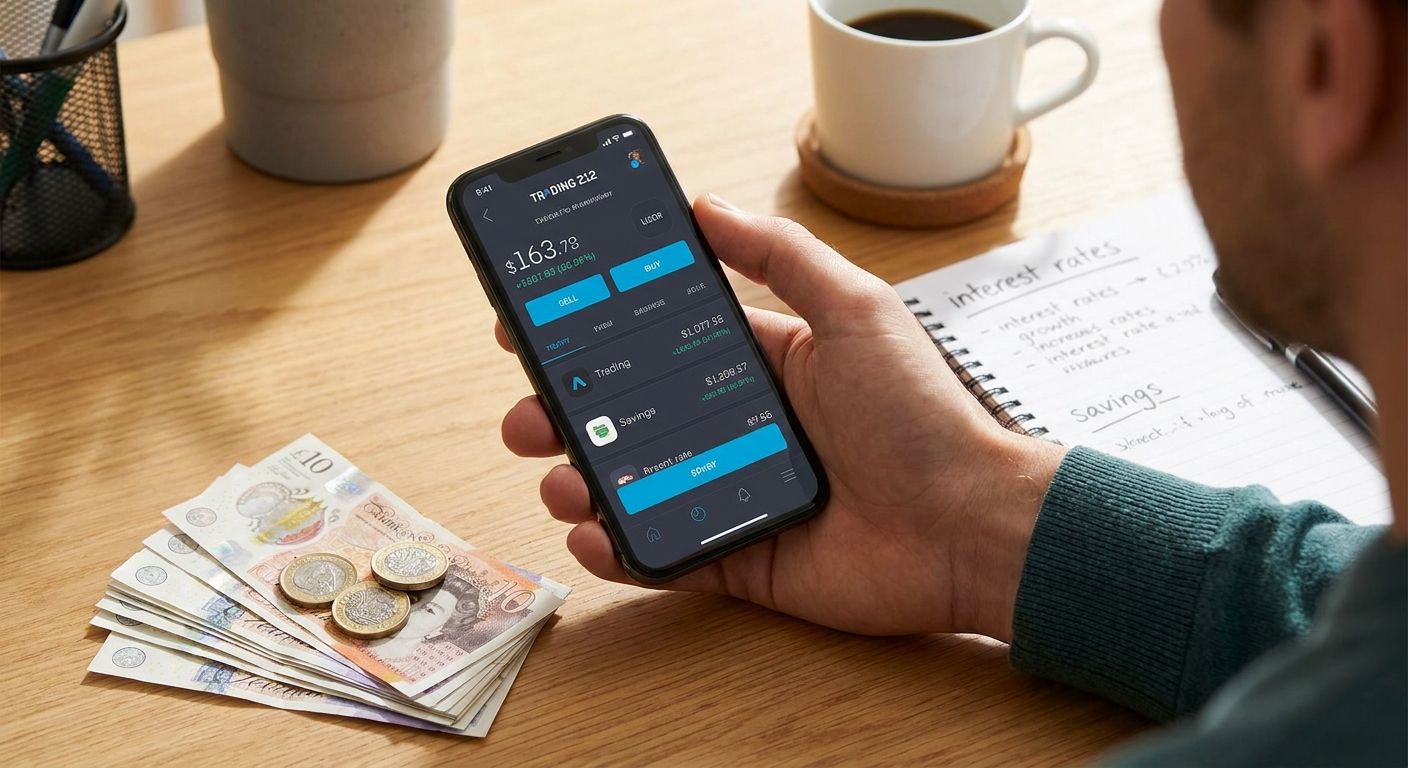
Trading 212 pays interest on the cash sitting in your account between trades, and in 2026 that detail matters more than it used to. Rates on ordinary bank savings have stayed sticky while broker cash yields moved every time a central bank changed course, so the trading 212 interest rate question is no longer a footnote - it's part of picking a broker.
- Trading 212 interest rate tracks central bank benchmarks across EUR, GBP, and USD balances in 2026 - Consider it if you hold cash between trades.
- Trade Republic is the closest head-to-head competitor on interest income - Buy only after comparing the live rate on both apps.
- Rates are variable, not fixed, so a comparison from January 2026 can be outdated by the next central bank meeting.
- German investors should cross-check BaFin-regulated alternatives before parking large balances - Skip any platform that won't disclose its current rate upfront.
Why This Matters
Uninvested cash used to just sit there, earning nothing while you decided what to buy. Now most regulated European brokers pay something on it, and the gap between the best and worst payers has widened since central banks pulled rates down from multi-year highs. If you keep a EUR 5,000 buffer while you wait to deploy it, the interest rate on that cash is not a rounding error - it's real income compounding while you sit on the sidelines.
Trading 212 built its interest feature into the core app rather than bolting it on as an afterthought, which is why it comes up constantly in the broker comparisons InvestBeacon tracks across 14 European markets. But "pays interest" is not the same as "pays the best rate for you." The answer depends on your currency mix, your balance size, and what you're already paying in fees elsewhere.
Who This Is For
This guide is for investors who routinely hold uninvested cash inside Trading 212 - between funding and buying, right after selling a position, or as a deliberate cash buffer sitting in the same app used for stocks and ETFs. It's for the investor who wants one platform handling both the invested and uninvested side of a portfolio, instead of shuttling cash back to a separate savings account every few weeks.
It's also for anyone comparing Trading 212 against Trade Republic, a German neobroker, or another regulated European platform specifically on the interest question - not on trading fees or ETF selection, which is a separate comparison. If your idle balance never runs above a few hundred euros, the rate barely moves the needle. This matters most once uninvested cash sits in the four-figure range or higher.
What to Look For in a Trading 212 Interest Rate Comparison
A headline rate tells you almost nothing on its own. Before deciding whether Trading 212's interest on uninvested cash beats the alternative, run it through five checks.
How the Rate Is Set and How Often It Moves
Trading 212's cash interest is a variable rate pegged to central bank benchmarks - broadly, the ECB deposit rate for EUR balances, the Bank of England base rate for GBP, and the Fed funds rate for USD. That means the figure displayed in the app today can shift within days of a rate decision, in either direction. Check the live rate inside the app before planning around it; any number you read in a review, including this one, can be stale by the time you fund an account in 2026.
Currency Coverage - EUR, GBP, and USD
Not every euro-based investor holds euros only. If your account carries GBP from a UK employer or USD from a US-listed ETF's dividend, check whether interest applies to each currency bucket separately or only to your base currency. Trading 212 pays across multiple currencies, but the rate and terms are not identical bucket to bucket, so a multi-currency holder needs to check each line item, not just the headline number on the homepage.
Where the Cash Actually Sits
Interest on uninvested cash is only as good as the protection standing behind it. Confirm whether your balance sits in a segregated client account, which regulator oversees the broker - BaFin in Germany, the AFM in the Netherlands, the FCA in the UK, AMF in France - and what deposit protection scheme applies if the broker itself ran into trouble. A slightly higher rate is not worth it if the protection underneath is weaker than a BaFin-regulated alternative.
Caps and Tiers on Interest-Eligible Cash
Some platforms pay the advertised rate only up to a threshold, then a lower rate - or nothing - on the excess. Before parking a large balance, check whether Trading 212 or a competitor caps the interest-eligible amount. An investor sitting on EUR 20,000 in cash needs a different answer than one holding EUR 500, and the headline rate rarely tells you where that cap kicks in.
Fee Interaction
Interest income means little if it's offset by custody fees, inactivity charges, or FX conversion costs elsewhere on the account. Compare the net effect: what you earn on idle cash minus what you pay to hold or move it. A broker with a lower headline rate but zero custody fees can still come out ahead on a net basis by the end of 2026.
See how brokers compare on cash interest
Check current rates and fees across regulated platforms in Europe for 2026.
Top Picks for Earning Interest on Uninvested Cash
These are the options worth putting side by side with Trading 212 before you decide where idle cash sits for the rest of 2026.
Trading 212 - the built-in default. Trading 212 pays interest on uninvested cash across three currencies - EUR, GBP, and USD - directly inside the same app used to trade, with no separate savings product to open. The rate tracks central bank policy, so it moves without you doing anything, and interest accrues daily rather than as a lump sum at year-end. For an investor who wants one login and one statement, that convenience is real. Verdict: Buy for hands-off cash management, but check the live rate against Trade Republic before moving a five-figure balance.
Trade Republic - the direct competitor. Trade Republic built part of its brand on cash interest, and it's the platform most European investors compare Trading 212 against on this exact question. The Trade Republic cash savings and interest income page walks through how its rate is structured and which currencies qualify. Both platforms move their rates with the same central bank decisions, so the gap between them can close or widen within a single quarter of 2026. Verdict: Consider it side by side with Trading 212 - run the comparison the week you're deciding, not from memory of an older number.
Germany-specific comparison - the local-regulation check. If you're filing taxes in Germany and want a broker with BaFin oversight specifically, the best online broker in Germany comparison ranks platforms on fees, cash handling, and interest together, not interest alone. That matters because a broker with a marginally lower cash rate but simpler German tax reporting can still come out ahead net of hassle. Verdict: Consider it if BaFin regulation and German tax handling outweigh chasing the single highest rate.
ETF-plus-cash combo - for investors running a savings plan. If most of your uninvested cash is just waiting for the next ETF savings plan installment rather than sitting idle long-term, the best ETF broker for European investors comparison weighs interest on cash alongside savings-plan fees and fund selection. For that investor, a marginally lower cash rate paired with cheap recurring buys usually beats a marginally higher cash rate with expensive ones. Verdict: Buy the combo that minimizes total cost, not the single highest cash rate viewed in isolation.
What to Avoid
- Chasing the headline rate without checking the cap. A broker advertising a strong rate on the first EUR 5,000 and a token rate above that isn't better for a EUR 15,000 buffer than a flat, lower rate with no cap at all.
- Assuming the rate is fixed for 2026. Every platform named here, including Trading 212, pays a variable rate tied to central bank policy. A number you read in January can be wrong by the time the account is funded in March.
- Ignoring currency mismatch. Holding GBP cash in a EUR-denominated account and converting only when you buy can cost more in FX spread than the interest earns back over several months.
Verdict Comparison
Use this as a starting checklist, then confirm live rates in-app before moving money - none of these figures are fixed for the rest of 2026.
| Pick | Currencies covered | Regulatory home | Fee interaction | Verdict |
|---|---|---|---|---|
| Trading 212 | EUR, GBP, USD | Regulated across multiple EU jurisdictions | No custody fee to offset | Buy for hands-off use |
| Trade Republic | EUR primarily | BaFin (Germany) | Check FX fees on non-EUR activity | Consider side by side |
| Germany-matched broker | Varies by platform | BaFin | Varies - compare in full guide | Consider for German filers |
| ETF-focused broker | Varies by platform | Varies by country | Savings-plan fees matter more than cash rate | Buy lowest total cost |
FAQ
What is the Trading 212 interest rate in 2026?
Trading 212 pays a variable interest rate on uninvested cash that tracks central bank benchmarks for EUR, GBP, and USD balances. Check the live figure inside the app, since it changes with ECB, Bank of England, and Fed decisions.
Is the Trading 212 interest rate better than Trade Republic's?
Neither consistently beats the other across all of 2026 because both track the same central bank moves with a margin. Compare the live rate on both apps the week you're deciding rather than relying on an older comparison.
How is Trading 212 interest paid?
Interest on uninvested cash accrues daily inside the account rather than arriving as a single annual payment. It shows up in the cash section of the app alongside your invested balance.
Is Trading 212 cash covered by deposit protection?
Cash protection depends on which regulated entity holds your account and where it's based, so check the specific investor compensation scheme that applies to your country. This varies across the 14 European markets Trading 212 and its competitors operate in.
Does Trading 212 pay interest on GBP and USD cash, not just EUR?
Yes, Trading 212 pays interest across multiple currencies including EUR, GBP, and USD, but the rate and terms are not identical for each currency bucket. Check each currency line separately if you hold a mixed-currency balance.
How often does the Trading 212 interest rate change?
The rate can change whenever the relevant central bank moves its policy rate, which can happen several times a year. There's no fixed schedule, so treat any published figure as a snapshot rather than a locked-in number for 2026.
Is interest on uninvested cash taxable?
Interest income is generally taxable in most European jurisdictions, though the exact treatment depends on your country of tax residence. Check local rules or a tax advisor rather than assuming it's handled automatically.
What happens to interest if I invest all my cash?
Interest only accrues on the uninvested portion of your balance, so a fully invested account earns no cash interest. That's expected behavior, not a platform error.
One Last Thing
The rate Trading 212 shows on the cash tab today is not a promise for the rest of 2026 - it's a snapshot tied to whatever the ECB, the Bank of England, or the Fed just decided. Investors who get the most out of uninvested cash interest are the ones who re-check the number every time a central bank meets, not the ones who compared once in January and assumed it held.